Garageband Zoom Out
GarageBand ’11 offers a visual depiction of a song using a timeline. When you drag a loop to the timeline, or record into a track, iLife’s GarageBand represents the music with a region in the timeline showing graphically what the sound looks like:
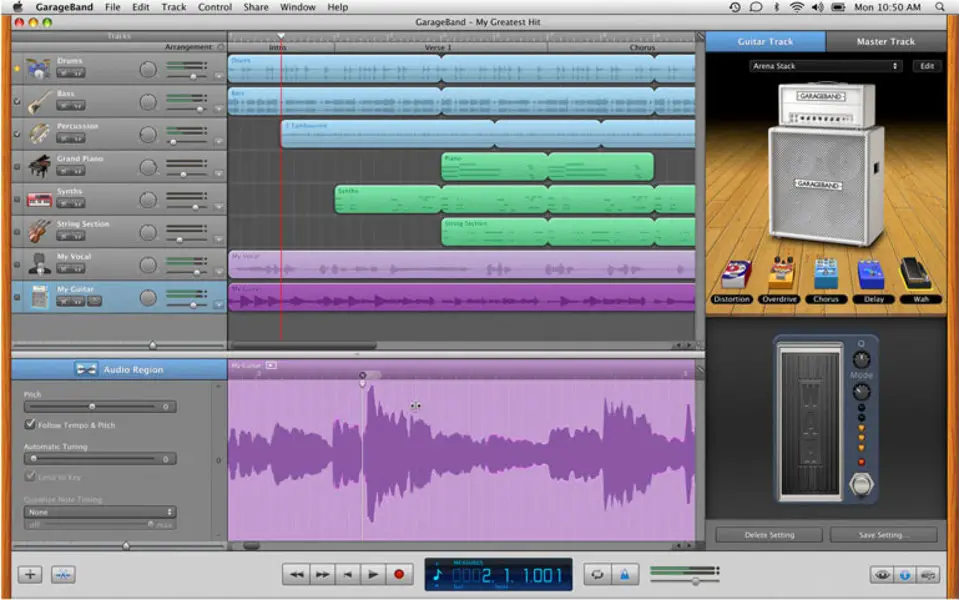
Real Instrument regions: Loops are blue regions showing waveforms, and recordings are red waveforms while recording, and then purple waveforms after you finish recording.
It is perfect, especially for the time right before the manual mixing (e.g. At a dinner), automated background music in restaurants or a at parties.Countless widgets make it possible to easily adapt the program to your own needs. Even font sizes and font types can be changed with a simple mouse click. You will be supported by 7 real time effects, a unique 31-band equalizer, 6 hot cue buttons, smart synchronized loop and built-in 16 channel sample player.Hours of music with perfect transitions – the integrated Auto-DJ makes it possible. Ultramixer 6 free download.
Software Instrument regions: Both recordings and loops are green regions showing dashes on a musical scale. (Dashes with higher pitch are in the upper part of the region, and dashes with lower pitch are in the lower part.)
As building blocks for your song, regions help you define pieces of music that may change, depending on the arrangement. You might, for example, record into a separate Software Instrument track a guitar part that accompanies a chorus and then copy the region of that single performance to the same places in the timeline as each chorus in the song — so that you need to perform the guitar part only once.
2019-7-31 Setup: Squier VM Mustang Zoom MS-70CDR Vox Pathfinder 15 Recorded with a Sennheiser e609 into a Focusrite Scarlett 18i8 into Garageband. No extra processing done aside from balancing levels. For clean tones sans Pedal Friends, check out the Clean Tone. On GarageBand for my iPhone 5s, I'm trying to make a piece of music on the keyboard feature. However, you're limited to about 9 or 10 keys on which to make a melody and it's hard to side scroll to either higher or lower keys during a recording, and it's a faff to have to record over something to be able to fit the keys in which you want. Zoom in or out. Once you begin. In times of troubleshooting—for example, when you’re trying to figure out why a certain GarageBand “document” is so big—you can actually open up one of these packages to see what’s inside. To do so, Control-click the GarageBand song icon and, from the shortcut menu, choose Show Package Contents, as. Edit regions in GarageBand for iPad. Regions are the building blocks of a GarageBand song. When you record a Touch Instrument, use the Drummer or add Apple Loops to a song, a region appears in the instrument’s track in Tracks view.
Changing the timeline grid in GarageBand
- You can also zoom in and out through the (Command – Left or Right arrow key). Merging Tracks Together (Command + J) Another incredibly useful editing tool in Garageband is the (Command + J) function, which allows the user to essentially combine or merge the tracks together.
- 83 time-saving Hotkeys for Garageband 10. Extensive, exportable, wiki-style reference lists for Keyboard Shortcuts/Hotkeys.
- You can also zoom in and out through the (Command – Left or Right arrow key). Merging Tracks Together (Command + J) Another incredibly useful editing tool in Garageband is the (Command + J) function, which allows the user to essentially combine or merge the tracks together.
The timeline beat ruler shows the divisions of time in either beats and measures or minutes and seconds — depending on whether you choose Time or Measures in the LCD at the bottom of the GarageBand window.
You can use the beat ruler to align musical regions precisely. The timeline offers a grid to snap these segments into place. To turn on the grid, choose Control→Snap to Grid.
You can also set the grid to different musical note values, such as quarter notes, eighth notes, sixteenth notes, 30-second notes, quarter note triplets, and eighth note triplets. To set the grid to a different note value, click the grid button in the upper right corner of the timeline and then choose a note value from the menu. You can set the grid to Automatic so that it becomes more precise as you zoom in or out using the timeline zoom slider under the track names.
Moving and resizing regions in the GarageBand timeline
The reason that these pieces of music are organized into regions is so that you can move them easily within tracks. You can even drag a region from one track to another (up or down), if you want the region to take on the characteristics (sounds and effects) of the destination track. When dragging regions, here’s what you need to know:
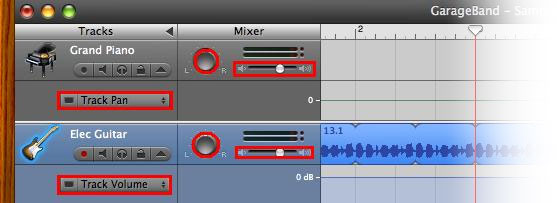
Real Instrument regions can be moved only to other Real Instrument tracks, and Software Instrument regions can be moved only to other Software Instrument tracks.
When you drag a region over another region in the same time slot, the region underneath is shortened to the edge of the region you’re dragging over it. If you completely cover a region with another region, the region underneath is deleted.
You also resize regions, making them shorter or longer, as described here:
Zoom Video Conferencing Free
You can shorten a region so that only the visible part of the region plays.
You can also lengthen a Software Instrument region, adding silence — but only to Software Instrument regions; Real Instrument regions can only be shortened or returned to their original lengths.
To resize a region, move the pointer over the lower half of either the right or left edge of the region — the pointer changes to the resize pointer (two arrows pointing sideways). You can then drag the edge of the region to shorten or lengthen it.